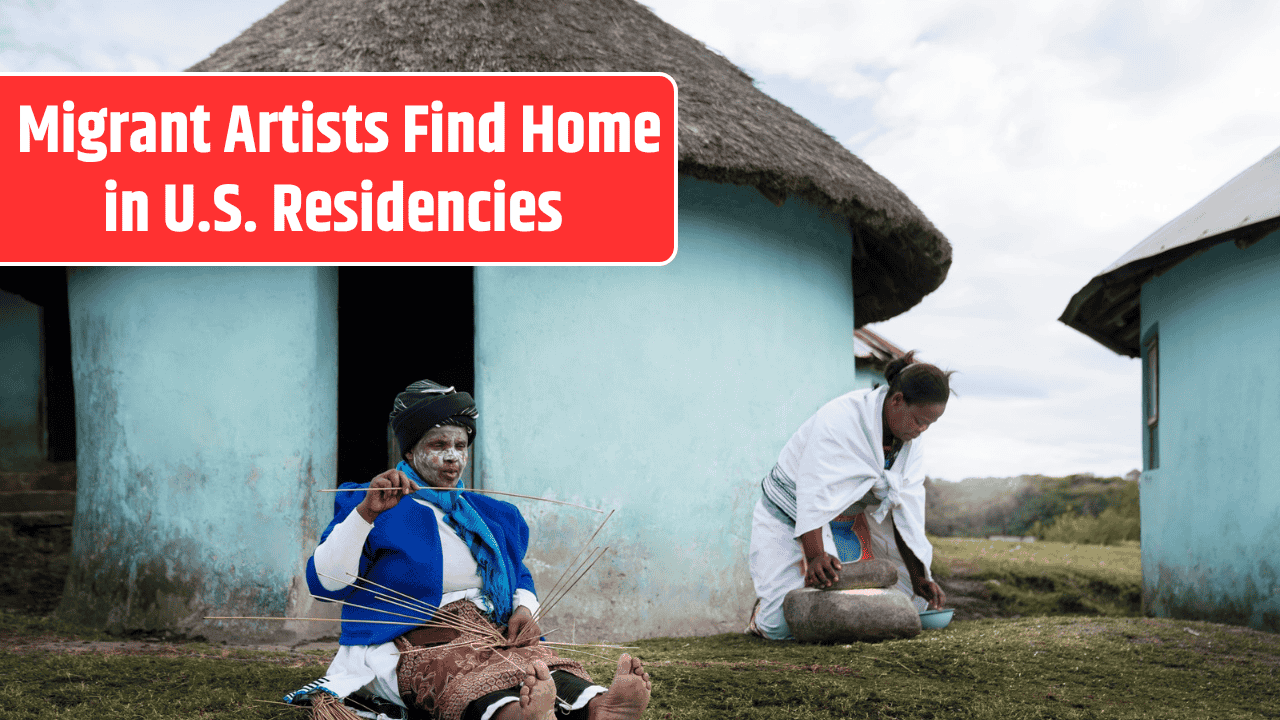
In recent years, a growing number of U.S. art nonprofits are stepping in to provide vital support for migrant artists—through residencies, fellowships, mentoring, and safe-haven programs. These efforts are helping artists who have moved from abroad, or who face displacement, to continue their creative practice, engage with new communities, and gain access to resources that have often been out of reach.
What once may have been seen as purely benevolent gestures are now emerging as strategic interventions in the contemporary art world—recognising that migration and mobility are central to global creativity, and that artists who cross borders bring new voices, experiences and social perspectives that enrich the cultural landscape of the United States.
Why Residency Support for Migrant Artists Matters

Migration has long shaped American culture—but the realities for migrant artists can include disrupted careers, language or cultural barriers, fewer institutional connections, and in some cases precarious immigration status. Residency programs that engage specifically with migrant or immigrant-background artists help overcome some of these barriers by providing:
- Studio space, time and stipend, enabling artists to work uninterrupted and build new networks.
- Mentorship, professional development and exposure, helping artists translate their practice in a new context.
- Legal, social or logistical support, especially for artists arriving from abroad or in transition.
- Community engagement and visibility, offering platforms for migrant-artists’ voices and stories that might otherwise remain marginalised.
These programs also signal a shift in how the arts sector sees migration—not as peripheral, but as central to innovation. Supporting migrant artists in residency helps diversify perspectives in museums, galleries and public art, while responding to the mobility of contemporary life.
Examples of U.S. Nonprofits & Residency Programs
Here are some notable organisations and programs in the United States that support migrant, immigrant or refugee artists:
- The New York Foundation for the Arts (NYFA) runs its Immigrant Artist Mentoring Program, providing foreign-born emerging visual and multidisciplinary artists with one-on-one career guidance, exposure and community. (Nyfa)
- The Artistic Freedom Initiative (AFI) offers residencies and fellowships to artists at risk—including migrants and refugees—helping them with relocation, legal support and year-long placements. (Artistic Freedom Initiative)
- The Vilcek Foundation is a nonprofit founded by immigrants that awards prizes and supports immigrant creators in the arts and sciences, elevating their work and contribution. (Wikipedia)
- The Arts Midwest “We the Many” initiative supported immigrant artists and artists of color to create residencies and community-based art projects in Midwestern towns, helping local nonprofits engage migrant artists directly. (Arts Midwest)

These programs differ in focus—some are long-term residencies, others mentoring, others safe-haven for at-risk artists—but they share a common thread: recognising that migration and artistic mobility demand tailored support.
What Residency Programs Offer Migrant Artists
Residency offerings vary, but many of the supports include:
- Studio or workspace: A dedicated place to make work, sometimes with housing included.
- Stipend, materials or travel allowance: Helping artists cover living expenses while working.
- Professional development: Access to mentors, critics, curators, networking events, exhibitions.
- Community-engagement opportunities: Projects often encourage interaction with local audiences, creating visibility for the artist’s background and practice.
- Legal/settlement assistance (in some cases): Especially for artists arriving under refugee/immigration transition scenarios (e.g., AFI’s support).
- Exhibition or presentation platform: The residency may culminate in a show, a public talk, or documentation that raises the artist’s profile.
For migrant artists, these supports are crucial—they mitigate disruption to their career, offset the instability of relocation, and create a bridge into U.S. art networks.
Challenges and Considerations

While the opportunities are significant, several challenges persist:
- Eligibility and accessibility: Some residencies still require artists to be U.S. residents or have certain visas, which may exclude newly arrived migrants.
- Cultural and language barriers: Migrant artists may face challenges in navigating U.S. art institutions, grant systems or community networks.
- Sustainability: Short-term residencies are valuable but may not address long-term career trajectories or integration.
- Representation versus tokenism: There’s a fine line between highlighting migrant artists as “diverse voices” and treating them as token additions without equitable support.
- Follow-through and visibility: After the residency, artists need sustained opportunities, gallery representation, and institutional backing, not only a one-time placement.
- Immigration and legal challenges: For some artists, unstable immigration status, travel restrictions, or lack of financial support can hinder full participation.
Residents and program alumni often emphasise that what matters most is not just the residency stay, but the ongoing network, recognition and career momentum that follow.
Why This Trend Is Growing
Several factors explain why U.S. art nonprofits are increasingly focusing on migratory artist support:
- Globalised art world: Contemporary art always crosses borders—artists move, collaborate internationally, and migration itself is an artistic subject.
- Social justice and inclusion: Art institutions face pressure to diversify their artists and narratives; supporting migrant artists aligns with equity goals.
- Narrative shift: Migrant perspectives offer new stories about identity, displacement, diaspora, belonging—rich material for contemporary art.
- Community relations: Many cities host growing migrant populations; fostering migrant-artists helps institutions engage with local cultural dynamics.
- Funding and philanthropy: Some funders and foundations prioritise immigration, refugee support and cultural integration—leading to increased resources for these residencies.
Because of these converging pressures and opportunities, residencies for migrant artists are not niche—they are becoming central to how U.S. art nonprofits think about their mission and programme design.
Looking Ahead: The Future of Migrant-Artist Residencies
What might the next phase look like? Some trends to watch:
- Longer-term placements and deeper career pathways: Residencies that transition into multi-year mentorship, gallery representation and institutional partnerships.
- Interdisciplinary and transnational collaboration: Migrant artists engaging in residencies that connect U.S. cities to artists’ home countries, creating bi-directional exchange.
- Increased local community integration: Residencies moving beyond “artist comes in” to embedding migrant-artists in community-led projects, local culturally specific practices.
- Institutional shifts in representation: Museums, galleries and nonprofits may hire more migrant curators, advisors, and integrate immigrant-artists into their core programming rather than “special” residencies.
- Enhanced data and evaluation: More tracking of outcomes—how many artists obtain gallery representation, how residencies influence career trajectories and community dynamics.
- Advocacy and policy linkage: Residency programmes linking to broader immigration, labour and cultural policy issues—art as platform for advocacy, not just creation.
In this way, supporting migrant artists is not only about individual creative opportunity—it shapes how art institutions define their future role in a mobile, multicultural society.
FAQs
Who counts as a “migrant artist” for these programmes?
Typically, a migrant artist may be someone born abroad and now living in the U.S., an immigrant, refugee, or artist with recent relocation experience. Some programmes also include children of immigrants or artists who navigate transnational identity.
What exactly does a residency provide?
It varies but generally includes studio/work space, time to make work, sometimes housing or stipend, professional development, mentorship, and opportunities for exhibition or community engagement.
How long are these residencies?
Duration varies widely—some are short-term (several weeks), others are several months or even a year. Some may then segue into longer-term support.
How can a migrant artist find these opportunities?
They can start by checking nonprofit art-residency databases (such as the Artist Communities Alliance directory) and looking at nonprofits with explicit immigrant support (e.g., NYFA, AFI, Vilcek). Networking in local art associations, immigrant artist collectives and applying broadly helps.
Why should arts institutions invest in these residency programmes?
Because they broaden artistic voices and narratives, build community relevance, respond to demographic realities of migration, and help institutions remain culturally dynamic and inclusive in a globalised era.