
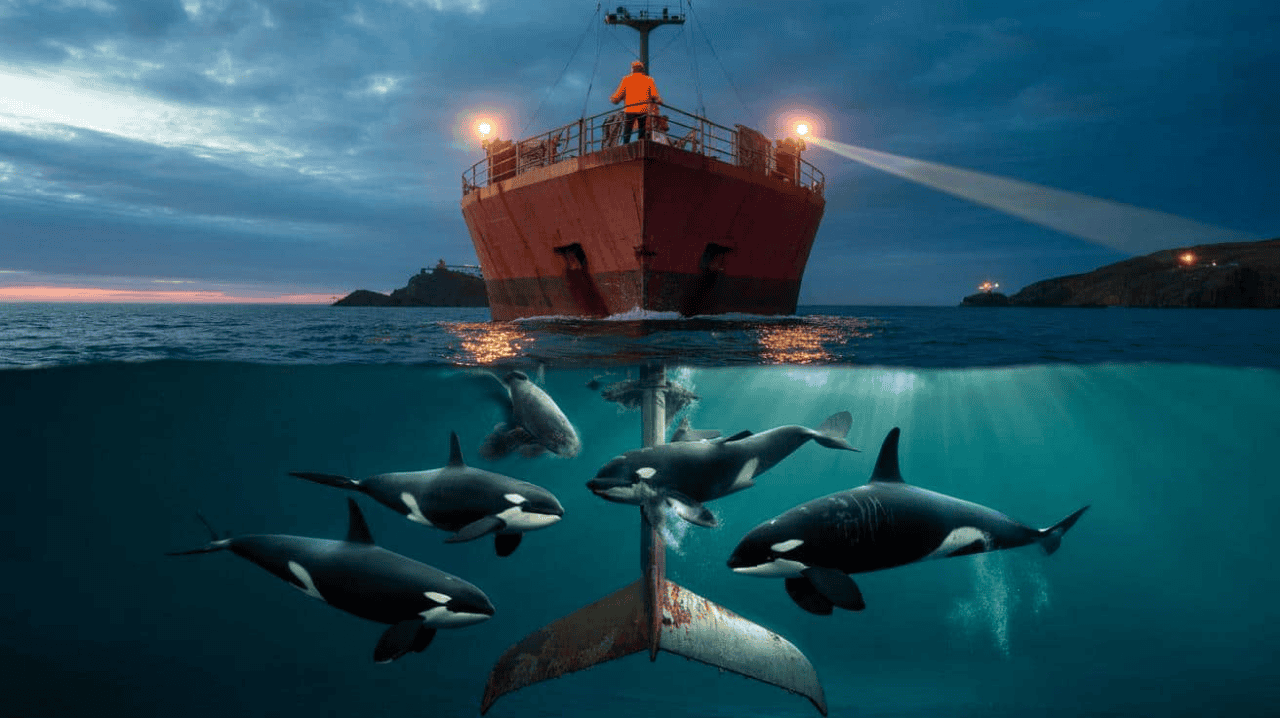
What began as rare encounters off the Iberian coast now shows up in captain’s logs from Galicia to the Strait of Gibraltar—and in wary chatter over VHF. Experts say it looks learned, even coordinated. Insurers are watching. Mariners are changing habits mid-season.
The Night the Rudder Stopped Answering
It started like a shiver through the deck plates. A coastal freighter off Cape Finisterre rolled on a glassy swell, the bridge bathed in soft blue. Routine watch, steady engine hum—until the helm jerked as if from a hidden hand. The autopilot clicked off. The rudder grew heavy, resisting command. A deckhand ran aft and froze. Black-and-white shadows ghosted through the wake—three, then five—dorsal fins cutting through moonlit water. Then, silence. The ship wasn’t alone, and the rudder no longer obeyed.
A Pattern Emerges Along Iberian Waters

Maritime authorities on both sides of the peninsula have logged an unmistakable trend: orcas approaching from astern, fixating on rudders, and working in tight, seemingly coordinated teams. Even the most cautious scientists are using phrases like social learning and coordinated behavior. The animals linger for minutes—nudging, pushing, sometimes bending steel. It’s methodical. Practiced. Almost procedural.
Since 2020, over 700 documented encounters have been recorded by the Grupo de Trabajo Orca Atlántica (GTOA). Most involve sailing yachts under 15 meters, though recent reports include trawlers, ferries, and whale-watch boats. In May 2024, a sailing vessel sank near the Strait of Gibraltar after repeated rudder strikes. Smaller fishing boats off Galicia have had gear tangled and steering compromised. Whatever’s happening, the orcas seem to know where control lives.
Why the Rudders?
Theories vary. Some scientists describe a behavioral “fad,” a kind of oceanic trend spreading through a small social group of orcas. Rudders vibrate, hum, and churn water in ways irresistible to tactile, echolocating creatures. Others see deeper causes: changing prey availability—especially bluefin tuna—forcing adaptation and exploration.

The consensus? Curiosity and learning, not aggression. As Spain’s Ministry for Ecological Transition notes, the Iberian orca subpopulation faces ecological stress, making these behaviors as much a symptom as a mystery.
The Mariners’ Playbook: Slow, Quiet, Predictable
Captains in known hotspots now follow three golden rules: slow down, stay quiet, remain predictable. When orcas approach, many reduce speed, center the helm, and take engines out of gear to minimize vibrations. It’s counterintuitive—but it works.
“Rudder-first behavior is striking because it’s smart,” explains marine ecologist Dr. Marta Guerra. “They’ve learned where to press to get a reaction. Our job is to remove that reaction.”

The advice from port authorities across Galicia and Portugal is simple: treat these encounters like weather, not war. Move crew off the stern, log position and time, and resist the urge to fight the sea. The calmer the response, the shorter the visit.
| Recommended Action | Purpose | Duration |
|---|---|---|
| Reduce speed to under 5 knots | Minimize rudder vibration | Immediate |
| Shift engine to neutral | Reduce turbulence | During approach |
| Keep helm steady | Prevent attracting attention | Continuous |
| Log position/time | Support data collection | Always |
| Avoid loud noises | Prevent escalation | Always |
Lessons from the Water
Some stories sound almost cinematic. A Galician skipper describes cutting speed, slipping into neutral, and watching two juvenile orcas trace his rudder while a larger female hovered nearby like a teacher. After six long minutes, they drifted off. “No bravado,” he said later, lighting a cigarette. “Just relief.”
From Vigo to Cascais, dockside conversations circle around theories—dwindling fish stocks, playful mimicry, even vengeance myths spun by tabloids. But marine biologists are clear: there’s no evidence of hostility. Just intelligence meeting infrastructure.
Policy and Industry Response
Spain and Portugal have issued updated navigation advisories through their maritime directorates, mapping “interaction zones” and urging route adjustments for smaller craft. (Source: Gobierno de España & Portuguese Environment Agency).
Insurers, meanwhile, are recalibrating premiums along affected corridors, and shipowners have revised standing orders to include orca encounter protocols. In coastal cafés, captains joke about “orca clauses” in coverage—but behind the humor, risk is real.
Beyond the Headlines
Yes, “orca attacks” make for gripping headlines. But reality, as usual, is quieter and stranger. Most encounters end uneventfully. Large commercial vessels, whose rudders sit deep and churn massive prop wash, are rarely affected. Smaller boats—yachts, trawlers, research craft—exist closer to the sensory threshold of these intelligent mammals. The orcas’ curiosity may be inconvenient, but it’s also a mirror of our own.
The Sea Keeps the Receipts
There’s something poetic about it all. Ships run on routine; orcas run on attention. Somewhere in between lies a new kind of coexistence—tense, adaptive, oddly intimate. The smartest response so far has been patience: gather data, dial down drama, and wait for the behavior to fade.
Still, it’s hard to forget that image—black fins trailing in moonlight, intelligent eyes studying our inventions. A reminder that the ocean isn’t empty space. It’s inhabited. Watching. Remembering.
And like any good story, this one travels fast through water.
FAQs
How many orca-boat encounters have been reported so far?
Over 700 documented cases since 2020, mostly along the Iberian Peninsula.
What should captains do during an encounter?
Reduce speed, neutralize the engine, and avoid sudden rudder movements or noise.
Are larger ships at risk?
Very rarely. Most incidents involve smaller vessels with accessible rudders.
Could climate change be influencing this behavior?
Possibly. Shifting prey distribution and stress on marine ecosystems may encourage new behaviors.
Is there any long-term solution?
Ongoing data collection and coordinated navigation advisories are helping vessels adjust routes seasonally to avoid known pods.