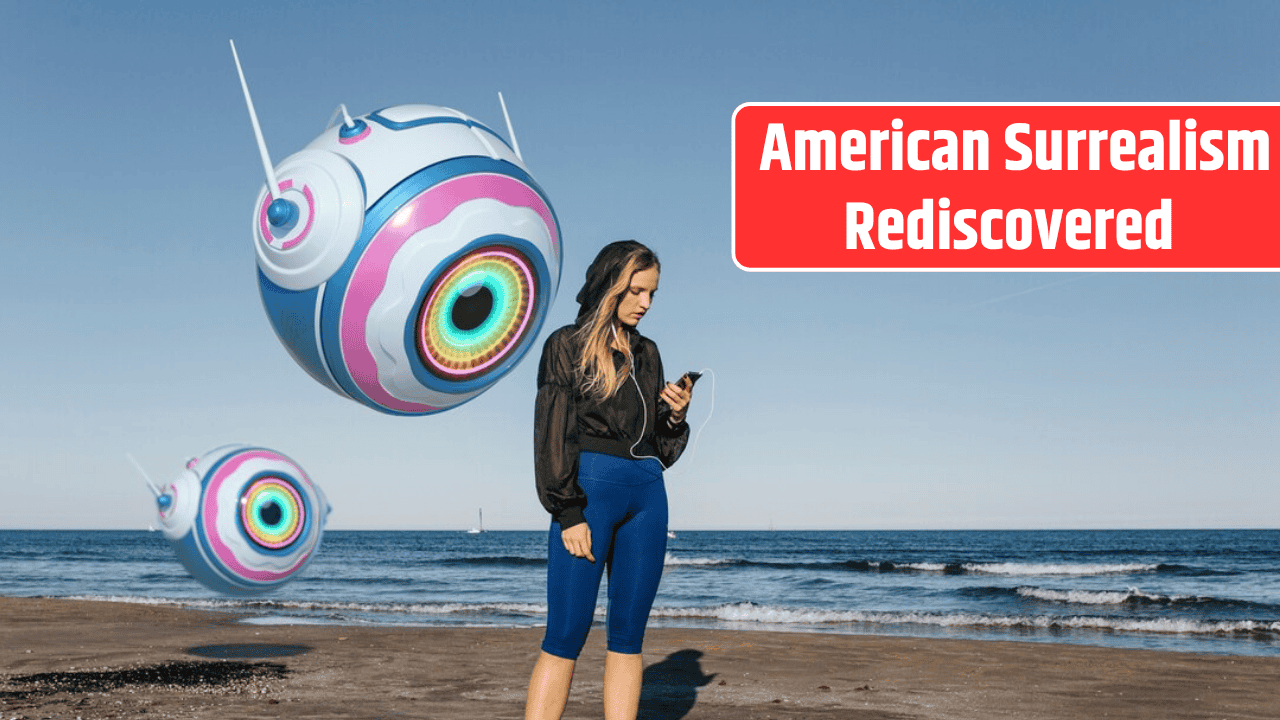
For decades, the story of Surrealism has been told through a distinctly European lens — populated by the dreamscapes of Dalí, the collages of Max Ernst, and the poetry of André Breton. Yet, as museums across the United States reexamine the complexities of 20th-century art, a new narrative is emerging. American artists who worked in surrealist modes — often in isolation or far from the Parisian avant-garde — are finally being given their due.
A new wave of major museum retrospectives, from the Whitney Museum of American Art to the Carnegie Museum of Art, is reframing American Surrealism as a homegrown movement — one that was equally visionary, experimental, and deeply reflective of the American psyche.
Reclaiming a Forgotten Movement

The term “American Surrealism” has long been treated as an oxymoron, as though Surrealism could only belong to Europe. But the new exhibition “Sixties Surreal” at the Whitney Museum challenges that assumption head-on.
Featuring more than 100 artists from across the U.S., the show rewrites the cultural narrative of the 1960s by positioning surrealist thinking — the irrational, the uncanny, the dreamlike — as a defining force in American art. The exhibition expands beyond the familiar New York School to include creators from Chicago, Los Angeles, and the American South, many of whom were overlooked by history.
Curator David Breslin describes it as “flipping the ’60s on its head — instead of focusing on Pop and Minimalism, we’re uncovering the psychological, mystical, and deeply human impulses that animated American art.”

Meanwhile, at the Carnegie Museum of Art in Pittsburgh, a landmark exhibition titled “Gertrude Abercrombie: The Whole World Is a Mystery” brings long-overdue attention to one of the most enigmatic figures in midcentury American painting. Abercrombie, who lived and worked in Chicago, created haunting, intimate dreamscapes filled with owls, barren trees, and self-portraits in surreal settings. Her work, once marginalized as “folk surrealism,” is now recognized as a singular vision that predates the feminist and psychological explorations of later decades.
Together, these retrospectives signal a major shift in how American institutions understand and present the surreal.
The American Psyche Through the Surreal
Where European Surrealism emerged from Freudian theory and postwar existentialism, American Surrealism was rooted in a different landscape — both literal and emotional.
For artists like Gertrude Abercrombie, Federico Castellón, Dorothea Tanning, Kay Sage, and George Tooker, Surrealism became a tool for exploring isolation, identity, and spirituality in the American experience. Their imagery often drew from the vastness of rural America, the claustrophobia of small-town life, and the dreamlike promise (and anxiety) of modernity.
Chicago, in particular, played an outsized role in developing an American strain of the surreal. The city’s distance from the art-market hierarchies of New York allowed artists like Abercrombie to experiment freely. Her work, often depicting lone figures in sparse interiors, reflects a distinctly Midwestern emotional surrealism — one defined not by spectacle, but by quiet strangeness.
Similarly, artists like Hughie Lee-Smith and O. Louis Guglielmi infused social realism with dreamlike unease, transforming everyday scenes into psychological landscapes.
Museums and Scholars Rewriting the Canon
For the first time, major U.S. institutions are not only exhibiting but contextualizing American Surrealism within a larger art-historical framework. The Whitney’s “Sixties Surreal” (2025) includes archival materials, letters, and journals to illustrate how surrealist ideas migrated into American counterculture — influencing everything from Beat poetry to experimental cinema.
The Carnegie Museum’s Abercrombie retrospective, meanwhile, reveals how her intimate dream worlds were shaped by jazz music, literature, and friendships with figures like Dizzy Gillespie and Sarah Vaughan. By connecting her work to broader networks of cultural exchange, the exhibition positions Abercrombie not as an outsider, but as a central figure bridging Surrealism and American modernism.
These exhibitions arrive amid a wider museum movement toward rebalancing the canon — one that elevates women, regional artists, and those historically excluded from mainstream narratives. Curators now argue that American Surrealism was not a derivative movement but an organic evolution responding to uniquely American anxieties: technology, industrialization, race, and existential dread in a rapidly changing world.
The Visual and Emotional Terrain
Visitors to these retrospectives encounter a distinctly American visual language of the surreal:
- Barren landscapes and twilight skies symbolizing psychological emptiness or spiritual searching.
- Everyday objects rendered uncanny — chairs, houses, or musical instruments floating in impossible spaces.
- Solitary figures, often self-portraits, navigating dreamlike interiors that mirror inner turmoil.
- Hybrid realism, where precision of detail gives way to inexplicable dream logic.
In Abercrombie’s paintings, for instance, self-portraits are cloaked in moonlight, framed by desolate plains or echoing hallways. Each image feels both intimate and infinite — the artist as her own muse and mystery.
The Sixties Surreal exhibition, on the other hand, explores surrealism’s political edge: antiwar imagery, psychedelic visions, and explorations of gender and identity that would later feed into the feminist art movement.
Why American Surrealism Matters Now
This renewed focus arrives at a time when the boundaries between reality and imagination feel increasingly porous. Artists and audiences alike grapple with uncertainty, digital dislocation, and fractured identity — themes that echo those of the surrealists.
By recovering the American surrealists, museums are not merely excavating history; they are offering tools for the present. These works remind us that Surrealism is not just about dreams — it’s about survival, reinvention, and the search for meaning in an irrational world.
As art historian Terri Kapsalis notes in her essay for the Abercrombie catalog:
“American Surrealism was not escapist. It was a language of coping — of reassembling the self amid chaos.”
Looking Ahead
The success of these retrospectives is likely to inspire more. Plans are underway for touring exhibitions, scholarly symposia, and digital archives that connect American Surrealism to contemporary artists influenced by its legacy — from the photomontages of Lorna Simpson to the dreamlike installations of Tschabalala Self.
Collectors and scholars are taking note as well. Art market data shows a sharp rise in demand for works by midcentury surrealists, particularly women and artists of color. Auction houses report growing interest in figures once overlooked by major institutions.
The long sleep of American Surrealism, it seems, is finally ending.
FAQs
What defines American Surrealism compared to European Surrealism?
American Surrealism often focuses on personal psychology, social commentary, and regional symbolism rather than Freudian dream analysis or political revolution. It’s more introspective and grounded in the realities of American life.
Who are key figures being rediscovered?
Gertrude Abercrombie, Dorothea Tanning, Federico Castellón, O. Louis Guglielmi, and Hughie Lee-Smith are among the artists gaining new institutional recognition.
What museums are currently leading this reevaluation?
The Whitney Museum of American Art and the Carnegie Museum of Art are leading with major retrospectives, with other institutions expected to follow.
Why is this happening now?
Curators and scholars are reexamining midcentury American art through more inclusive, intersectional perspectives, expanding beyond the New York-centric canon of Abstract Expressionism and Pop.
How can audiences engage with these rediscoveries?
Visitors can explore the exhibitions, attend lectures, and access digital archives. Many museums are also releasing catalogs and online resources to extend the scholarship beyond gallery walls.